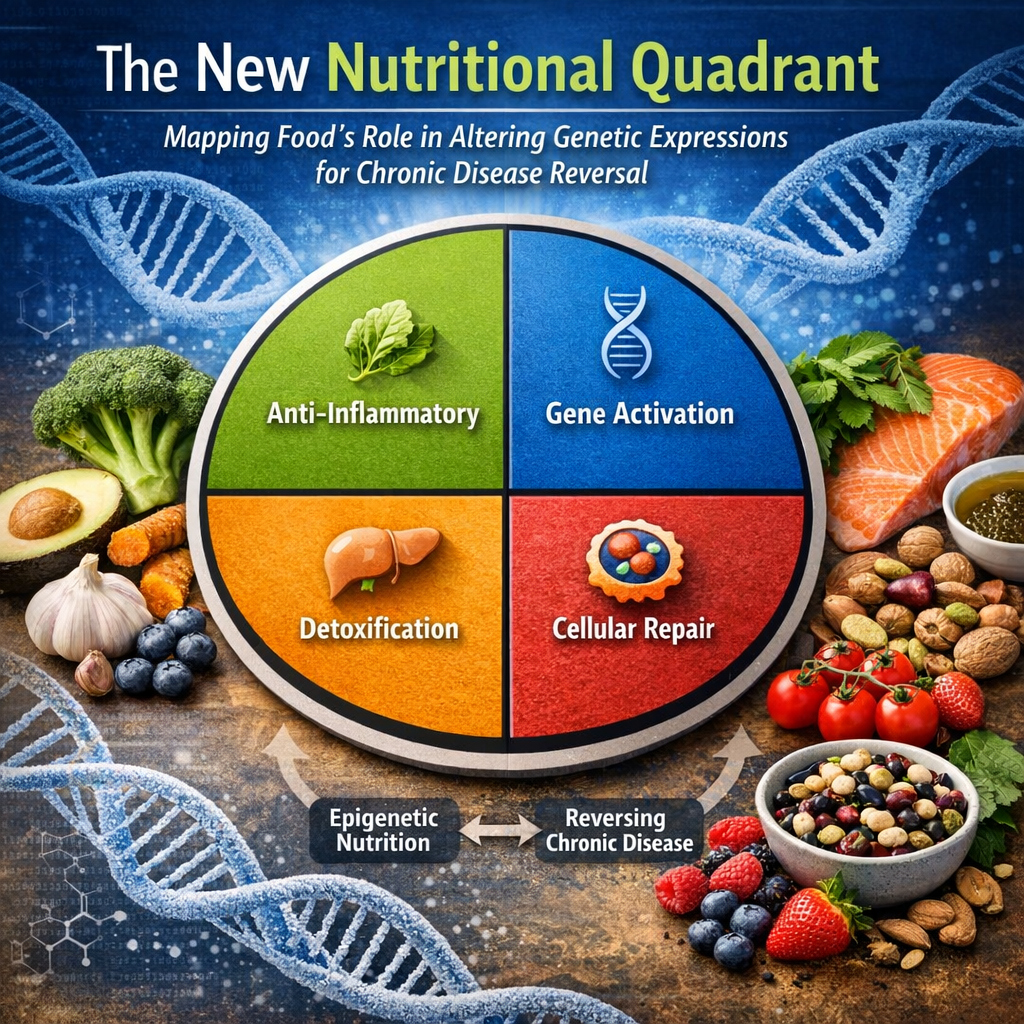
The New Nutritional Quadrant: Mapping Food’s Role in Altering Genetic Expressions for Chronic Disease Reversal
Introduction
In the rapidly evolving landscape of health and wellness, the interplay between nutrition and genetics has emerged as a cutting-edge approach to understanding and reversing chronic diseases. While it’s long been accepted that a balanced diet is crucial for maintaining good health, recent research delves deeper, suggesting that what we consume can directly influence our genetic expressions—a concept known as nutritional genomics or nutrigenomics. This groundbreaking field suggests that food can serve as a powerful agent in not only preventing but even reversing the genetic predispositions that lead to chronic diseases like diabetes, heart disease, and certain cancers.
At the heart of this discussion is the realization that our genes are not an unchangeable blueprint but rather a dynamic template influenced by various external factors, including diet. When we talk about altering genetic expressions, we refer to epigenetics—modifications on our DNA that do not change the sequence but can turn genes on or off. Nutrients and bioactive compounds found in natural foods can interact with these epigenetic mechanisms, potentially switching off harmful genes or activating beneficial ones.
This intersection of food and genetics offers an empowering perspective for individuals seeking natural cures and homeopathic treatments. Imagine unlocking the potential of age-old remedies with new scientific insights, essentially offering a nutrition-based strategy to manage and potentially reverse chronic illnesses. For years, health experts and traditional healers have touted the benefits of herbal and homeopathic remedies. Now, backed by scientific inquiry, these approaches are gaining recognition as viable options within a holistic healthcare paradigm. Nutrigenomics serves as a bridge between the ancient wisdom of plant-based diets and modern scientific validation.
As the prevalence of chronic diseases continues to escalate globally, understanding and leveraging the power of diet-induced genetic modification could be transformative. This new nutritional quadrant may well be central to future dietary guidelines and public health policies aimed at chronic disease prevention and management.
Features
The scientific inquiry into nutrigenomics is expanding rapidly, shedding light on the profound ways in which food components can influence genetic activity. A seminal study by the National Institutes of Health (NIH) highlighted how certain dietary patterns could modulate gene expression profiles associated with inflammation and metabolism, which are critical in the development of conditions like obesity and cardiovascular disease [NIH Study](https://www.nih.gov/news-events/news-releases).
Another compelling area of research is the role of phytochemicals—compounds found in plants—like flavonoids, carotenoids, and isothiocyanates. A survey published in the Journal of Nutritional Biochemistry discusses how these compounds can have antioxidant properties and influence the regulation of genetic pathways linked to cell growth and apoptosis, an important process in cancer prevention [Journal of Nutritional Biochemistry](https://www.sciencedirect.com/science/article/pii/S0955286309001458).
Furthermore, the emerging research on the microbiome, the community of microorganisms residing in the human gut, adds another layer to this complex interaction. A healthy gut microbiome, significantly influenced by diet, can affect gene expression and strengthen the body’s immune responses. The study from Frontiers in Microbiology underscores the potential of probiotics and prebiotics in modulating gene expression and improving metabolic health [Frontiers in Microbiology](https://www.frontiersin.org/articles/10.3389/fmicb.2020.00797/full).
Significantly, a clinical trial outlined in Nature Communications demonstrated that adherence to a Mediterranean diet, rich in whole grains, fruits, and vegetables, can lead to transcriptional changes in genes related to inflammation and immunologic function. This empowers individuals to make informed dietary choices aimed at combatting chronic diseases at the genetic level [Nature Communications](https://www.nature.com/articles/s41467-017-01439-z).
These studies fortify the understanding that strategic dietary changes can act as a catalyst for biochemical changes within our genetic makeup. This evolution of thought encourages a shift in dietary paradigms where food is not only fuel but a tool for genetic and, therefore, health optimization.
Conclusion
The potential of nutrition to alter genetic expression opens a new frontier in the battle against chronic diseases. By harnessing the principles of nutrigenomics, individuals can make dietary choices that support favorable genetic activity, thus fostering health and resilience against chronic conditions. The fusion of traditional dietary wisdom with contemporary scientific inquiry provides a holistic approach that could redefine preventive healthcare. As we continue to map the new nutritional quadrant, the dynamic relationship between food and our gene expressions holds promise for a future where chronic diseases can be managed and possibly reversed not only with medications but through strategic nutritional interventions. As this field progresses, further research and education will be pivotal in empowering individuals to take control of their genetic destinies through accessible dietary solutions. Through a deeper understanding and application of nutrigenomics, a proactive, individualized approach to healthcare may become a reality.
By exploring these nutritional strategies and their biological implications, we open doors to innovative, sustainable treatments that align seamlessly with the body’s natural capabilities for healing and adaptation. Such approaches are poised to become central in chronic disease management for future generations.
Concise Summary
The emerging field of nutrigenomics explores how nutrition can influence genetic expressions, with potential to prevent and reverse chronic diseases. By affecting epigenetic mechanisms, nutrients can modulate gene activity, offering a powerful avenue for healthcare. Research underscores the roles of phytochemicals, the microbiome, and dietary patterns like the Mediterranean diet in this process. As this science progresses, it promises revolutionary approaches to managing chronic conditions, emphasizing food as a tool for genetic and health optimization. Through understanding and application, nutrigenomics may redefine preventive healthcare and empower individuals in their health choices.

Dominic E. is a passionate filmmaker navigating the exciting intersection of art and science. By day, he delves into the complexities of the human body as a full-time medical writer, meticulously translating intricate medical concepts into accessible and engaging narratives. By night, he explores the boundless realm of cinematic storytelling, crafting narratives that evoke emotion and challenge perspectives.
Film Student and Full-time Medical Writer for ContentVendor.com