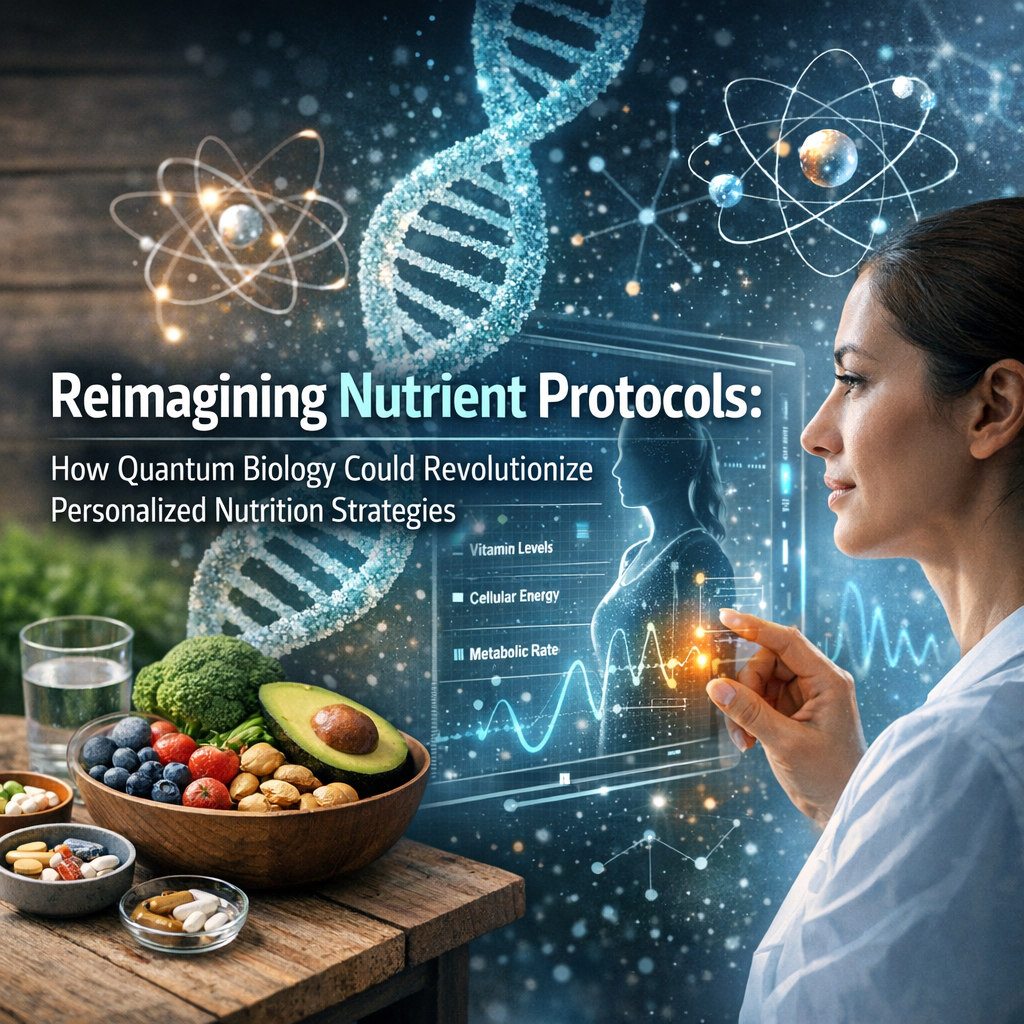
Reimagining Nutrient Protocols: How Quantum Biology Could Revolutionize Personalized Nutrition Strategies
Introduction:
The complexity of human health demands a paradigm shift in how we approach nutrition. Conventional nutrient recommendations, based primarily on macronutrient ratios or calorie limits, are rapidly becoming outdated due to scientific breakthroughs. An emerging area of interest is the fusion of quantum biology with personalized nutrition, which could fundamentally reshape our dietary guidelines.
Quantum biology, a groundbreaking field bridging quantum physics with biological phenomena, suggests that subatomic particles and quantum processes may play pivotal roles in human physiology. This challenges the conventional view that solely biochemistry governs cellular functions, positing instead that quantum mechanisms like electron tunneling and quantum entanglement may dictate many cellular processes such as enzyme function and DNA repair.
The central idea of quantum biology is that each individual’s unique quantum makeup affects how they respond to nutrients at a molecular level. This knowledge can enable nutrition strategies tailored not to population-level statistics but to specific quantum profiles, paving the way for a new era of precision nutrition. This approach aims to consider not only genetic makeup but also the quantum state of an individual, which could influence how the body metabolizes food, repairs cells, and fends off disease.
The possibility that proteins, enzymes, and even DNA operate in part through quantum mechanics opens up exciting possibilities for individualized dietary interventions. For instance, specific quantum interactions might affect how efficiently a person absorbs and utilizes particular vitamins or minerals. Thus, personalized nutrition based on quantum biology could go beyond general advice like eating more leafy greens to offer more outcome-effective choices tailored to an individual’s unique biological makeup. Though still in its infancy, this merging of disciplines holds promise for advancing health and longevity through individualized dietary practices.
Features:
Scientific curiosity about quantum effects in biological systems isn’t new, but their roles in nutrition have only recently garnered attention. Numerous experimental studies have examined quantum effects in biological systems, although many focus on processes like photosynthesis in plants. A landmark study published in *Nature* in 2007 demonstrated that light-gathering macromolecules in algae captured and transferred energy using quantum coherence, suggesting a biological advantage in efficiency.
Human systems also seem to harness quantum principles. In 2019, researchers from the University of California, Los Angeles (UCLA) found evidence of quantum tunneling in enzymes, explaining otherwise inexplicable reaction speeds in certain metabolic pathways. These discoveries imply that nutrients and drugs could act differently based on individual quantum characteristics.
Moreover, personalized nutrition strategies are being refined by understanding quantum principles. Harvard’s recent initiatives in creating individualized nutrient profiles leverage genomic data but are starting to explore quantum biology principles. The interplay between epigenetics and quantum effects could eventually clarify why seemingly similar individuals experience different outcomes from the same diet.
Promising research is also linking quantum biology to the pharmacodynamics of herbal treatments. Some compounds in turmeric and garlic show unique interactions with cellular enzymes, which researchers believe could involve quantum effects. As science progresses, herbalists may identify which tinctures best align with an individual’s quantum biology.
Despite the promise, the journey from theory to practice is long. Critics often emphasize the young state of quantum biology and the need for more empirical evidence in human systems. Nonetheless, blending quantum physics with nutrition could revolutionize health optimization, fostering hope for dietary interventions that can proactively address health issues and extend vitality.
Conclusion:
The era of generic, one-size-fits-all nutritional advice may soon be overshadowed by techniques derived from quantum biology. By recognizing the complex quantum processes occurring within each cell, we unlock the potential for tailoring nutrition protocols to individuals’ unique biological frameworks. This vision promises improved health and well-being and the capability to create dietary regimens that address specific health afflictions and chronic conditions.
As this field matures, it might enable us to harness nature’s synergy more effectively, facilitating better results from natural cures, homeopathic remedies, and herbal treatments. While further empirical study is essential, exploring this untapped realm could usher in a golden age of nutrition characterized by the precision of quantum mechanics.
References:
1. Lambert, N., Chen, Y., Cheng, Y.-C., Li, C.-M., Chen, G.-Y., & Nori, F. (2013). Quantum biology. *Nature Physics*, 9(1), 10-18. [Nature](https://www.nature.com/articles/nphys2474)
2. Romero, E., Augulis, R., Novoderezhkin, V. I., Ferretti, M., Thieme, J., Zigmantas, D., & van Grondelle, R. (2014). Quantum coherence in photosynthesis for efficient solar-energy conversion. *Nature Physics*, 10(9), 676-682. [Nature](https://www.nature.com/articles/nphys3017)
3. Strategic Initiative on Quantum Nutrition, Harvard University. (2021). [Harvard](https://www.harvard.edu)
Concise Summary:
The integration of quantum biology with personalized nutrition promises a paradigm shift in dietary guidelines by leveraging quantum processes like electron tunneling and quantum entanglement. These insights enable nutrition strategies tailored to individual quantum profiles, advancing beyond traditional genetic considerations. Research highlights quantum effects in humans and their potential influence on enzyme function, DNA repair, and nutrient metabolism. As this emerging field develops, it holds the promise of enhanced health and personalized dietary interventions, although it requires further empirical validation to fully realize its revolutionary potential.

Dominic E. is a passionate filmmaker navigating the exciting intersection of art and science. By day, he delves into the complexities of the human body as a full-time medical writer, meticulously translating intricate medical concepts into accessible and engaging narratives. By night, he explores the boundless realm of cinematic storytelling, crafting narratives that evoke emotion and challenge perspectives.
Film Student and Full-time Medical Writer for ContentVendor.com