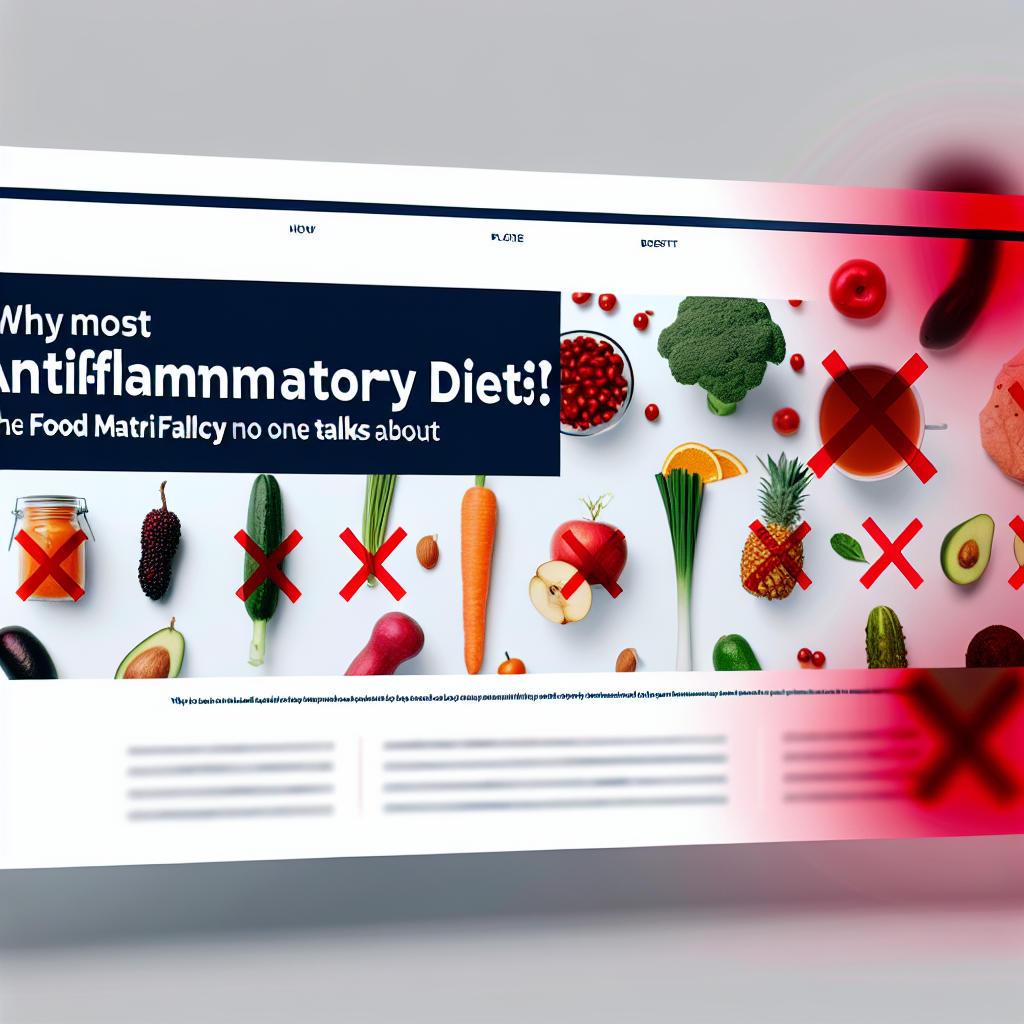
Why Most “Anti-Inflammatory” Diets Fail: The Food Matrix Fallacy No One Talks About
Introduction
**Inflammation** is increasingly recognized as a fundamental driver of many **chronic diseases**, including **heart disease**, **diabetes**, and even some **cancers**. As awareness grows, many people are turning to “anti-inflammatory” diets, hoping these dietary changes will quell their inflammation and improve their health. At face value, the concept is straightforward: avoid foods that cause inflammation and increase your intake of those that are anti-inflammatory. These diets often emphasize **whole grains**, **leafy greens**, **fatty fish**, and other foods rich in **omega-3 fatty acids** while recommending reductions in processed foods, sugars, and **trans fats**. However, despite popularization and good intentions, many individuals find that simply adhering to the food lists doesn’t always lead to the promised decrease in inflammation or improvement in overall health.
The crux of this issue lies in a frequently overlooked concept known as the **”food matrix”**. The food matrix refers to the physical and chemical interactions of nutrients and other compounds within whole foods. This complex web determines how nutrients are released, absorbed, and utilized in the body. Many anti-inflammatory diets fail to consider the food matrix’s role, focusing narrowly on singular nutrients rather than the broader context of how these nutrients interact within whole foods and meals. Ignoring the matrix can lead to ineffective dietary strategies and unmet health goals.
For instance, a diet rich in **omega-3 fatty acids** should not just focus on the intake of fish oil supplements—often stripped of context from their original form—but should also account for the complete food profiles like those found in whole fish. The performance of any diet, particularly those with health claims, hinges on more than just ticking off a list of anti-inflammatory foods. The intricate arrangement of a food’s nutrients and the resulting physiological effects must not be neglected.
**Food Matrix Impact on Health**
Scientific Understanding
In terms of scientific understanding, recent research underscores the importance of the food matrix in health outcomes. A review published in the [Annual Review of Nutrition](https://www.annualreviews.org/doi/10.1146/annurev-nutr-082117-051734) highlights that foods are not merely the sum of their nutrient parts; rather, their health impacts depend significantly on the food matrix. For example, the **bioavailability** and **bioactivity** of beta-carotene are enhanced in the presence of fat, illustrating how a carrot consommé could differ vastly in nutritional impact from raw carrots due to its matrix.
Additionally, a study published by the [American Journal of Clinical Nutrition](https://academic.oup.com/ajcn/article/108/2/343/5049686) explored how processing can alter the food matrix, affecting both the nutrient density and health impacts. For instance, **whole grains** confer health benefits largely due to their matrix, which preserves fiber and phenolics in close association, decreasing the glycemic impact and providing sustained energy release.
An analysis from the [Journal of the Academy of Nutrition and Dietetics](https://www.jandonline.org/article/S2212-2672(18)31589-2/fulltext) points out the critical role of the food matrix in **dairy products** too, noting that nutrient interactions within dairy foods influence digestive processes and absorption rates. This underscores why low-fat or skim dairy alternatives can have different impacts compared to their whole-fat counterparts, based on their altered matrix.
Understanding these complexities highlights why simplistic approaches towards anti-inflammatory diets may underperform. The food matrix ultimately influences antioxidant capacity, nutrient absorption, and overall metabolic responses, thus affecting inflammation.
Conclusion
The journey towards alleviating inflammation through diets should transcend mere lists of “good” and “bad” foods, embracing the complex, interdependent nature of nutrients as experienced within their whole food matrices. By appreciating and leveraging the **food matrix**, individuals can craft more effective, personalized anti-inflammatory dietary interventions. Going forward, nutrition sciences need to communicate these nuances more broadly, assisting people in making informed, impactful dietary changes that consider the full dimension of food choices. Embracing this conceptual leap may unravel doors to better health outcomes, truly harnessing the full potential of dietary strategies to combat chronic inflammation.
Confronting the food matrix fallacy allows us finally to move beyond ineffective, reductionist food prescriptions towards a holistic and sustainable approach to health and wellness.
**Concise Summary:**
Anti-inflammatory diets promising reduced inflammation often fail due to the overlooked concept of the **food matrix**, which includes the interactions and context of whole foods. Focusing solely on nutrient lists can mislead efforts, as nutrients’ effectiveness is tied to their presence in a specific matrix. Scientific studies highlight this matrix’s role in nutrient absorption and health impacts, showing why simplistic approaches fall short. By understanding and utilizing the food matrix, individuals can achieve better health outcomes, moving beyond reductionist methods towards holistic dietary strategies.

Dominic E. is a passionate filmmaker navigating the exciting intersection of art and science. By day, he delves into the complexities of the human body as a full-time medical writer, meticulously translating intricate medical concepts into accessible and engaging narratives. By night, he explores the boundless realm of cinematic storytelling, crafting narratives that evoke emotion and challenge perspectives.
Film Student and Full-time Medical Writer for ContentVendor.com